
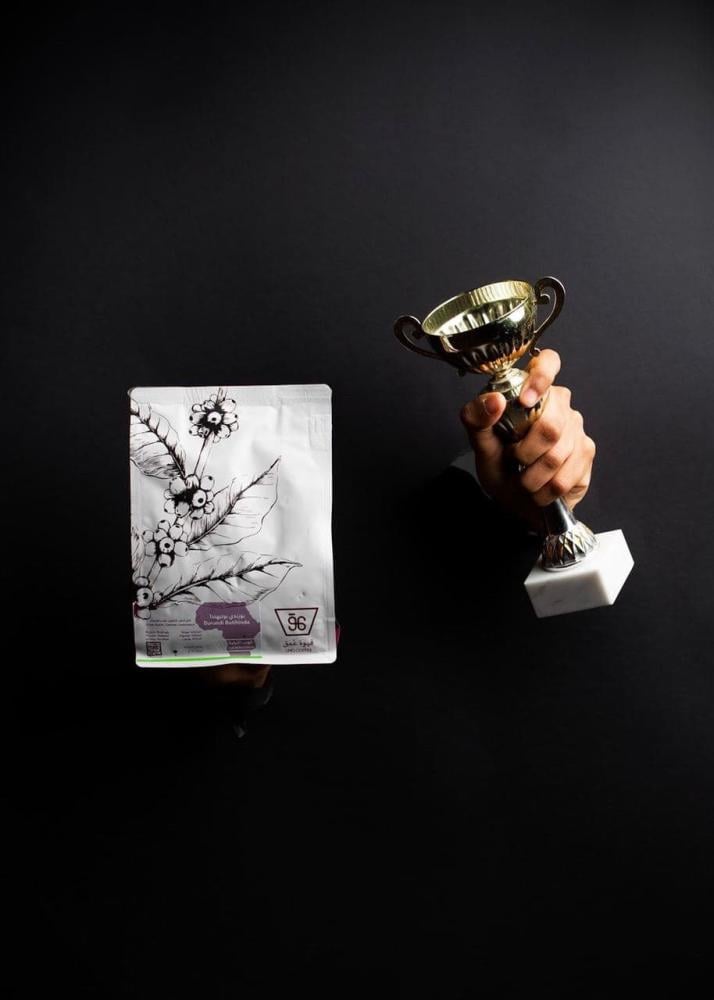

Elite Cup
The Elite Cup began as a personal initiative in 1999, specifically in Brazil. Now, twenty years later, the Elite Cup competition is present in 13 coffee-producing countries, with thousands of farmers participating annually, all dreaming of having their harvest designated as the "Elite Cup." Since its inception, and through the official establishment of the Coffee Quality Federation in 2002, the primary driving force behind the competition has been, and continues to be, boosting coffee farmers' incomes and increasing transparency in the industry.
Competition details:
The organizers of the competition make the participation process easy for every farmer, as all it requires is...
It is the delivery of a sample of the crop at no cost, so that there is no room for manipulation.
Each green coffee sample submitted to the competition is given a number so that the details of that sample are not known.
During the competition, only third-party auditors responsible for credibility will be present.
First stage:
At this stage, all the submitted samples are tested (as a sample) by a local committee. This committee evaluates the coffee out of 100, and coffees that score 86 and above go to the next stage, provided that the total number of coffees in the second stage does not exceed 150 coffees.
Phase Two:
Until the coffee enters To participate in this stage, the entire harvest must be delivered to the Coffee Quality Association and stored in dedicated warehouses managed by a third-party auditor. Fresh samples are taken from the harvest as it is transferred to the warehouses.
After that, all the coffees are evaluated again by a local committee, and the coffees that score 86 or higher advance to the third stage with a maximum of 90 coffees.
Third stage:
The coffees are evaluated again by the local committee, and coffees that score 86 and above advance to the fourth stage, with a maximum of 40 coffees.
Fourth stage:
Here, an international panel of taste experts comes in to evaluate the remaining 40 samples and select a maximum of 30 coffees to move on to the next stage.
Fifth stage:
The coffees are tested again to ensure their quality, and coffees that score 87 or higher gain the “Elite Cup” designation and advance to the online auction. Details of those coffees are also taken so that they can be shared with the auction participants and remain on the Union’s website as a reference.
Stage Six:
In the final stage, the ten coffees that received the highest score from the previous stage are evaluated one last time to determine the top ten.
After the competition:
After the competition is completed, the final stage of processing and sorting of the winning crops is completed, and then they are packed into vacuum-sealed bags weighing 15 kilograms each. Samples are sent to those wishing to enter the electronic auction.